

Dear friends and colleagues,
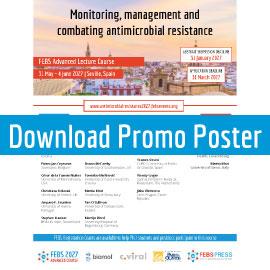
Antimicrobial resistance (AMR) has emerged as one of the most urgent threats to global public health, silently undermining decades of progress in infectious disease control. The FEBS Advanced Lecture Course 'Monitoring, Management and Combating AMR' is specifically designed for early-stage researchers from both industry and academia and represents a comprehensive exploration to deepen the multidisciplinary aspects of AMR, spanning from monitoring/surveillance, molecular mechanisms up to the design and development of innovative targeted strategies.
The program opens by framing the scale of the crisis, translating surveillance data into strategic health priorities, quantifying the global burden of bacterial resistance with modern AMR monitoring tools. Building on this foundation, a substantial portion of the course addresses the biological underpinnings of resistance and persistence, covering biomaterial-associated infections, biofilm formation on microplastics, bacterial stress response systems, and signaling pathways governing survival in opportunistic pathogens such as Pseudomonas aeruginosa. Novel molecular targets are also explored, including bacterial G-quadruplexes as emerging drug targets and bioisostere-based approaches to antimicrobial design.
The course further highlights next-generation therapeutic strategies designed to circumvent traditional resistance mechanisms: light-activated porphyrin-based photosensitizers, smart nanosystems for targeted antimicrobial delivery, adjuvant therapy platforms for high-throughput screening, immunotherapies against bacterial infections. and the implementation of magisterial phage therapy as a clinical alternative to conventional antibiotics. Complementing on these innovations, sessions on host–pathogen interactions, from advanced infection modeling platforms to pathogen–immune dynamics in pediatric populations, provide mechanistic insights essential for informed drug discovery.
Together, these topics illustrate the shift from reactive antibiotic use toward proactive, mechanism-informed, and technologically advanced approaches to combating AMR. Participants will gain an integrated understanding of how surveillance data, molecular biology, and translational innovation converge to shape future strategies for infection control and antimicrobial stewardship, equipping them to engage critically with one of medicine's most urgent contemporary challenges.
With our best wishes,
Younes Smani, Carole Devaux, Mattia Mori
Course Organizers
 |
 |
Deadlines
FEBS has twin commitments to high-quality publications and the promotion of molecular biosciences. As a charitable academic organization,
FEBS uses income from the journals to fund its diverse activities, including support for FEBS Advanced Courses.




A charitable organization advancing research in the
molecular life sciences across Europe and beyond.